Minnesota Fraud
For as long as there has been money, there has been fraud.
Fraud isn’t unique to modern times. Humans have been trying to cheat systems since Ancient Greece. Approximately 300 BC is earliest known record for fraud, when a Greek merchant tried to sink his own ship for an insurance payout. Fraud shows up whenever there is pressure, opportunity, and a story someone can tell themself to justify it.
The COVID pandemic didn't create fraud, but it did create a perfect storm that maximized fraudulent activities. Nationally, federal agencies (Government Accountability Office, IRS) estimate that billions of dollars, up to hundreds of billions, were lost to pandemic‑era fraud and has resulted in more than 3,000 people and companies charged nationwide... so far!
COVID fraud is a national problem, not a Minnesota‑specific one. The fraud that occurred in MANY states is federal fraud, with federal dollars, from a federal program with little federal oversight. The fraud that happened in Minnesota is just a small sliver of the total fraud that happened nationwide during the COVID era programs. Minnesota’s biggest fraud case, Feeding Our Future, was estimated at $250-300 million in fraud. That is serious money and accountability is required. But it is still just a fraction of the fraud that happened nationwide, and the consequences rendered to Minnesotans at a federal level is positively absurd given the 100+ billions of dollars of fraud that occurred in New York, Arizona, Georgia, California, Illinois, Kansas, Louisiana, Ohio, Alabama, and Texas.
And let us not forget: Despite the (hundreds of) billions of dollars in pandemic fraud that happened nationwide, Minnesota was one of the first states to raise red flags for fraudulent activities. Our Minnesota agencies questioned suspicious claims, denied reimbursements (and got sued and lost in the courts for that denial), documented irregularities, and escalated concerns to federal authorities. Minnesota agencies sounded the alarm and that led to the subsequent federal investigation.
So what needs to happen next?
Minnesota must do the work to tightening oversight. I support legislation that ensures stronger documentation requirements, more compliance staff, improved communication with federal partners, modernized and streamlined systems, heightened transparency, and reforms based on independent audits. Similar to "too many cooks in the kitchen," too many administrative departments creates an situation of having too many managers, not enough doers, and an environment ripe with confusion, inefficiencies, redundancies, and low morale. It is time we simplify and clarify the hierarchy of oversight so that we can ensure that this degree of fraud never happens in the state of Minnesota again. Because although fraud may not be going anywhere, we can do a better job of catching it, stopping it, and prosecuting it.
And this work of reforming oversight has already started with several bills introduced and several failed, often because partisanship got in the way. That partisanship is part of what makes the inflated claim of "billions in Minnesota fraud" so frustrating. The federal estimate is speculative and not supported by evidence. It is being used as a talking point rather than verified fact. It is one of the oldest political tricks out there: grab the biggest hypothetical number out there you can find, strip the context, and repeat it until people stop questioning it. Did you notice how that fraud kept inflating? From 250 million to half or more of $18 billion to 19 billion has been stolen depending who is talking... All this, with zero real evidence. In Gen Z terms, this is basically "trust me, bro." The burden of proof lies with the federal government, and until that proof is provided, this whole conversation looks less like oversight and more like partisanship with a side helping of distraction from a domino effect of missteps and administrative failures.
Minnesotans deserve better than manufactured outrage. We deserve real solutions.
Below is a synopsis (with sources) for what happened with the Feeding our Future fraud that rocked our state.
The Nitty Gritty:
The feeding our Future Fraud
Fraud is a pretty big discussion point right now in Minnesota, so let's talk about the fraud. But first, let's start by clarifying that tackling fraud is NOT a partisan issue. The idea that the Minnesota DFL were complacent in combatting or even complicit in fraud, lacks substance and is nothing more than political strategizing leading in to an election year.
Let's get started by highlighting what has evidence of has actually occurred (in contrast to the millions to billions of dollars in fraud that has been claimed by the federal government without a shred of evidence). This is a breakdown of the Feeding our Future fraud. I've simplified it, but keeping transparency in mind, I've also included the primary government documents and have limited news articles, unless directly cited by a primary article, so you can make an informed opinion without concerns of media bias.
TLDR: In all of this, who is to blame?
The fraudsters, of course.
But the system failures that allowed the fraud to grow were widespread: federal, state, judicial, and organizational.
Important abbreviations:
FOF - Feeding Our Future
MDE - Minnesota Department of Education
CACFP - Child and Adult Care Food Program
SFSP - Summer Food Food Program
WHO - World Health Organization
USDA - United States Department of Agriculture
A Timeline of what happened
The timeline below was developed using dates and information provided by the Minnesota Office of the Legislative Auditor’s Exhibit A, federal pandemic policy, and court records and also includes dates and data for the COVID-19 emergency worldwide and specific to Minnesota. Additional supporting links are also provided.
***
2016 — Formation
Feeding Our Future (FOF) was founded on November 7, 2016 by Aimee Bock.
***
2017–2020 — Early Warning Signs
2017
In February 2017, FOF applied to become a Child and Adult Care Food Program (CACFP) sponsor. In April 2017, Minnesota Department of Education (MDE) denied the application due to concerns about finances, governance, and administrative capacity. FOF almost immediately appeals. In June 2017, MDE reversed its decision and approved the CACFP application.
* A note: CACFP is "a federal program that provides reimbursements for nutritious meals and snacks to eligible children and adults."
2018–2020
Between 2018 and early 2020, MDE received eleven complaints concerning FOF, including governance disputes (complaints 1,5), aggressive recruitment of sites (2,3,4,6,9,10,11), allegations of kickbacks (7), and concerns about program implementation (8).
In July 2018, FOF was allowed to receive reimbursements for claimed CACFP meals and snacks. In August 2018, FOF claimed nearly 13,000 meals and snacks.
From December 2018 to February 2019, MDE conducted its only administrative review of FOF and issued 22 findings requiring corrective action. MDE promised a follow‑up review within 6–9 months. This follow‑up never occurred.
Failure #1: MDE identified problems but did not complete the required follow‑up review.
***
Early 2020 — Pandemic + Federal Waivers
In February and March 2020, the IRS revoked FOF’s nonprofit status, which was later reversed retroactively; COVID‑19 is declared a pandemic; and the US Department of Agriculture (USDA) issued nationwide waivers that removed in‑person monitoring, allowed off‑site meal distribution, expanded reimbursement flexibility, and dramatically increased program size.
However, no federal fraud‑detection mechanism was created. States were left to administer a rapidly expanding program with no new tools or guidance.
Failure #2: Federal rules expanded the program without expanding oversight.
Time warp (a COVID-19 timeline): In the early months of 2020, little was understood about the virus. China experienced a lockdown because of a novel Coronavirus and the virus was spreading, but details provided by the Chinese government were sparse. In late January, the WHO declared the 2019 Novel Coronavirus outbreak a Public Health Emergency of International Concern (PHEIC). In the United States, infections were documented to be spreading from person to person. By the end of March, it was announced that even with social distancing and public health measures, between 100,000 and 240,000 deaths were expected (there ended up being many hundreds of thousands of deaths more than that estimate and is currently at 1.2 million deaths in the USA). In Minnesota (timeline), schools were closed (March 15), restaurants were closed for in-person dining (March 16), and Minnesota's first death was recorded (March 21). There were growing concerns about the shortage of ICU beds, and on March 27, a Stay at Home Order went into effect, but allowed for continued essential activities and services. On April 4, more than 1,000,000 cases had been documented worldwide and by April 7, over 1,000 cases had been confirmed in Minnesota.
***
Spring–Summer 2020 — Rapid Expansion of FOF
In April 2020, MDE observed a site through a virtual site visit. Thirty children in fifteen minutes were served, but then the director's phone died. FOF claimed that 1,800 additional children arrived within the next hour. MDE did not investigate.
Also in April, FOF submitted applications for eight sites for participation in CACFP and FOF threatened litigation if its site applications were not approved by April 30. MDE approved those eight sites, plus an additional four.
In May, FOF applied to participate in the Summer Food Service Program (SFSP), which is also a federal program. Despite logging findings concerning a failure to accurately describe meal service, FOF was allowed to receive reimbursements for claimed SFSP meals and snacks.
In the months of April and May, MDE approved 1,100 sites for SFSP, after experiencing 73% growth from 2019 to 2020.
In August, MDE began - but does not complete - an administrative review of FOF’s SFSP operations, because virtual site visits were not working.
Failure #3: MDE repeatedly identified irregularities, but did not complete investigations.
Time warp (a global timeline and a Minnesota timeline): By April 7, the USA had 18,600 confirmed deaths and more than 500,000 confirmed cases. This made the USA the country with the most reported COVID-19 cases and deaths worldwide. In Minnesota, COVID-19 cases surpassed 1,000 on April 7 and 100 deaths on April 17. By May 30, deaths climbed to 1,000. By October 1, Minnesota had experienced 100,000 cases and 2,000 deaths.
---
Late 2020 — Complaints Spiked + Litigation Began
In October or November of 2020, after reaching out to the USDA Midwest Regional Office multiple times, MDE escalated concerns about FOF to the USDA inspector general, specifically about its growth.
MDE received complaints twelve through fifteen concerning management practices (complaint 12, 13, 15) and program implementation (14).
On November 20, 2020, FOF sued MDE for delays in processing applications.
On December 22, 2020, the court ordered MDE to process applications promptly and provide technical assistance to FOF. Also on that day, MDE denied all 68 FOF pending site applications, citing that FOF was already serving beyond the 50,000 per day limit.
Failure #4: The court order constrained MDE’s ability to slow or stop FOF’s expansion.
***
Early 2021 — Serious Deficiencies + FBI Involvement
MDE received complaints sixteen and seventeen, concerning and program implementation (complaint 16) and recruitment practices (17).
On January 15, 2021, MDE issued a serious deficiency notice to FOF based on the IRS revocation and audit issues.
On February 22, 2021, the FBI notified MDE of allegations involving kickbacks, improper reimbursements, and meals that were never served. This is the first moment federal law enforcement becomes involved.
***
March–April 2021 — MDE Attempts to Stop Payments
MDE received two complaints concerning program management practices (complaint 18, 19).
On March 29, MDE issued termination notices and stopped payments to FOF, citing that the January deficiencies had not been resolved. On March 31, a second set of serious deficiencies was issued to FOF by MDE, and was used as grounds to deny the FOF 2022 SFSP application.
In April, MDE provided information to the FBI regarding fraud suspicions with FOF and sites under its sponsorship. MDE met with USDA Midwest Regional Office about the serious deficiencies of FOF; USDA Midwest Regional Office supported the decision to stop payments and indicated that MDE has the authority to make that decision.
FOF filed a motion for a temporary restraining order and to hold MDE in contempt of court. FOF asserted that MDE could not lawfully withhold funds and that MDE's refusal to process FOF applications was a violation of the December 2020 court order.
During the April 21, 2021 hearing, the transcript shows Judge Guthmann* repeatedly stating that MDE cannot stop payments while creating a new validation system that did not previously exist (pgs 45-48). He warned that continued withholding could trigger new litigation (pg 64). At one point, both sides acknowledge that “the gloves are off (pg 71).”
On April 29, MDE denied all 184 pending CACFP and SFSP site applications, because of the March 31 deficiencies. FOF appealed.
Failure #5: The judge did not explicitly order payments to resume**, but his rulings made it challenging for MDE to keep payments stopped without triggering new litigation.
* Senior Judge John H. Guthmann was appointed on Mar. 27, 2008, by Governor Tim Pawlenty and elected in 2010, 2016, and 2022. He retired in 2024, prior to his term expiring in 2029.
** Although the judge did not specifically order payments to resume, he was documented several times saying that MDE cannot stop payments under the existing conditions, which is a directly contradicts his official statement released on September 23, 2022 in response to a statement (video of the statemet) made by Governor Tim Walz on September 22, 2022: "Feeding Our Future demanded that MDE make payments, and the court made it clear that if MDE were to continue the legal fight to withhold payments, MDE would incur sanctions and legal penalties. (quoted from Judge Guthmann's statement)” You can refer to the transcript (pgs 45-48), and be the judge as to what Judge Guthmann stated.
***
2021–2022 — Fraud Network Expands
Federal indictments and trial testimony from 2025 revealed that fraudsters recruited friends, relatives, business associates, and in some cases even used individuals’ identities without their knowledge or consent.
Lul Ali testified on February 11, 2025* that Aimee Bock coached her to participate in the fraud and “destroyed the Somali community” and that "They taught me how to do this."
Mohamed Ali Hussein (spouse to Lul Ali) later testified* that Aimee Bock told Lul Ali, "When you’re doing meal counts, write down that you provide 1,000 meals for kids every day. If you do 1,000 meals every day, you’re going to get more money, you’re going to get a big check, big benefit. [Bock] was saying American Dream, American Dream."
* Testimonies were obtained from news outlets and are included here in the timeline (despite being from 2025) to provide context for fraud expansion.
In May of 2021, the FBI began an investigation into FOF.
On June 18 and 23, FOF and MDE were back in district court. MDE was held in contempt because it had not allowed FOF to obtain site IDs in a timely manner and MDE was ordered to pay $47,000 in sanctions and legal fees.
On June 25, MDE denied all 15 pending SFSP site applications made by FOF. FOF appealed the same day.
On June 28, MDE's appeal panel issued a final decision that upheld the decision to deny 184 CACFP and SFSP site applications from the April 29 MDE denials. On July 14, MDE's appeal panel issued a final decision that upheld the decision to deny 16 CACFP and SFSP site applications from the June 15 MDE denials; an additional site was denied because the property owner of the proposed site did not give permission for FOF to operate there.
On July 6, FOF filed a second motion to hold MDE in contempt of court. On July 15, that motion was denied.
During this time, MDE received 10 complaints concerning program management practices (complaints 20-25, 27-30) and program implementation (26).
Failure #6: Fraudsters exploited pandemic rules, exploited community networks, and exploited the gaps between agencies while keeping legal pressure on MDE.
***
2022 to present — FBI Raids, Indictments, and Guilty Pleas
On January 20, 2022 the FBI executed search warrants at FOF and other locations affiliated with FOF. MDE terminated FOF participation in CACFP and SFSP and immediately stopped payments. In the following months, the FBI executed hundreds of search warrants and seizure warrants and reviewed over 1,000 bank accounts. The Department of Justice initially charges forty‑eight people, with more added later. More than fifty defendants plead guilty by 2024. The total fraud was estimated at $250 million.
Who is to Blame?
It's easy - and lazy - to point the finger of blame at a single entity or make this into a partisan conversation. But the reality is that this fraud was a cascade of failures beginning well before Governor Tim Walz's tenure began on January 9, 2019.
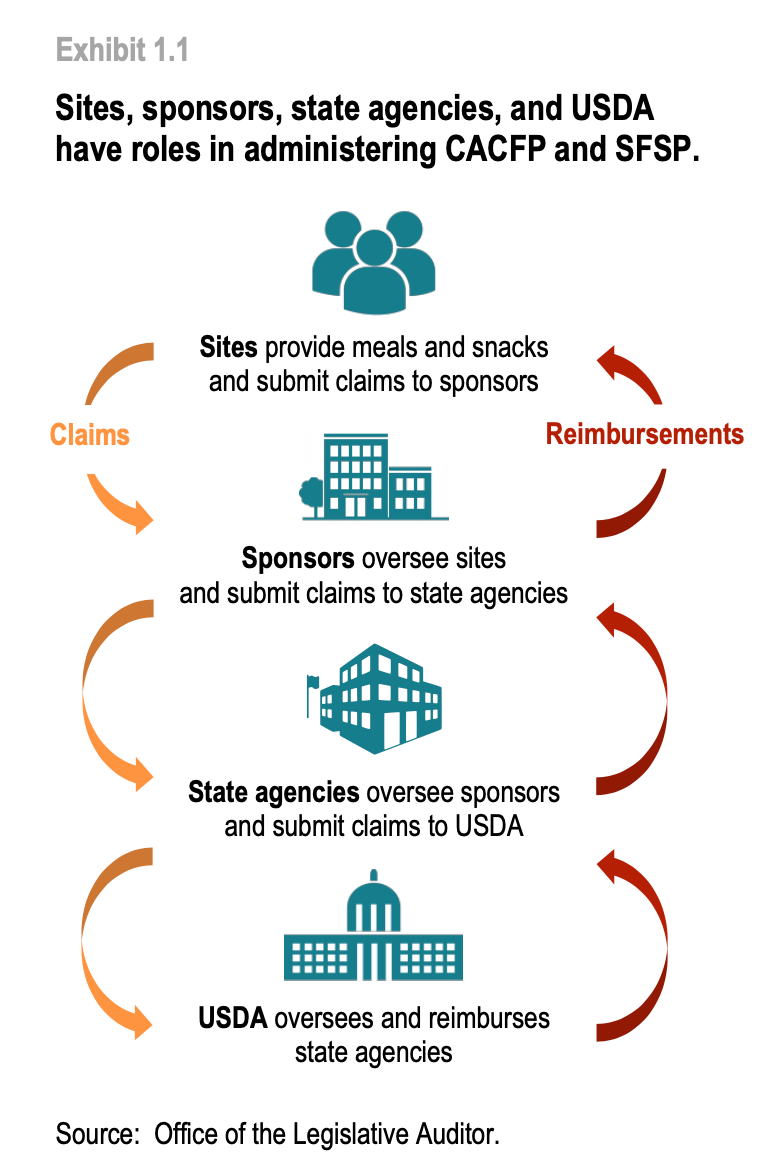
Below, I've listed what I think are just some of the major failures that led a perfect storm of the fraud progressing, expanding, and going unchecked. At all four levels (see Exhibit 1.1, below)- sites, sponsors, state agencies (MDE), and the USDA - there could have been proper safeguards put in place that could have minimized the occurrence and extent of fraud in that occurred in Minnesota, as well as across the United States.
1. Criminal failure: Fraudsters built networks, recruited participants, and fabricated meal counts.
2. Federal policy failure: Pandemic waivers expanded the program without expanding oversight.
3. State oversight failure (MDE): MDE missed follow‑up reviews, incomplete investigations, inconsistent enforcement, limited authority under federal rules.
4. Judicial constraints: Court rulings limited MDE’s ability to halt payments during active litigation.
5. Structural vulnerabilities: The program was built on trust, paperwork, and self‑reporting. It was ideal conditions for fraud during a crisis.
For the official review, see Oversight Report Conclusion.
What about the Care Center fraud controversy?
On December 26, 2025, a social media influencer released a video alleging widespread fraud at Minnesota day care centers with a specific emphasis of those run by people of Somali decent. The story became viral, Speaker Lisa Demuth revealed in a December 29, 2025 House Republican press conference that her caucus (the Minnesota House Republican Caucus) had worked with the influencer.
However, in the weeks that followed, the video was debunked by government agencies, fact checkers (Snopes), and actual news outlets across the political spectrum (MinnPost, Star Tribune, WCCO, Minnesota Reformer). But the damage had been already been done without any ability for course correction.
Day care fraud became a talking point. So what is the connection to Feeding our Future?To answer this question fully, we should review Child and Adult Care Food Program (CACFP) and Summer Food Service Programs (SFSP) organization. CACFPs and SASPs are federal nutrition programs that allow organizations like school programs, childcare centers, and nonprofit organizations (like FOF) to "sponsor" sites where meals and snacks are served (refer to Exhibit 1.1 above). Although these nutrition programs are federal programs, state agencies like the Minnesota Department of Education (MDE) are responsible for administering those programs. Some, but not all, of the day care sites that were targets in the viral videos had been sites with FOF sponsorship.